Home Hardware Shopper Journey
Background
Home Hardware wanted a refresh of their strategy in light of changing consumer values, communication channels, and increasing competition. In order to deliver all the insights that would be required to support a new strategy, several deliverables were included in the overall work. The journey map was the first deliverable and formed the foundation of subsequent work.
Goals for the Journey Map
To derive opportunities from the shopper’s experience that:
- uncover the moments of truth that will deliver the most differentiated shopper experience,
- identify the most influential communication touch-points,
- develop high-level and tactical opportunities that will address Home Hardware’s business priorities.
Methodology
Canadian Consumer Database (Vividata)
- demographics
- attitudes towards home improvement
- general attitudes
- purchase behaviour
- media usage
- media usage relied on for home improvement purchases
- sample size – DIY: 5,341 respondents; Fixers: 4,211 respondents; Home Shoppers: 6,264; Pros: 103 respondents
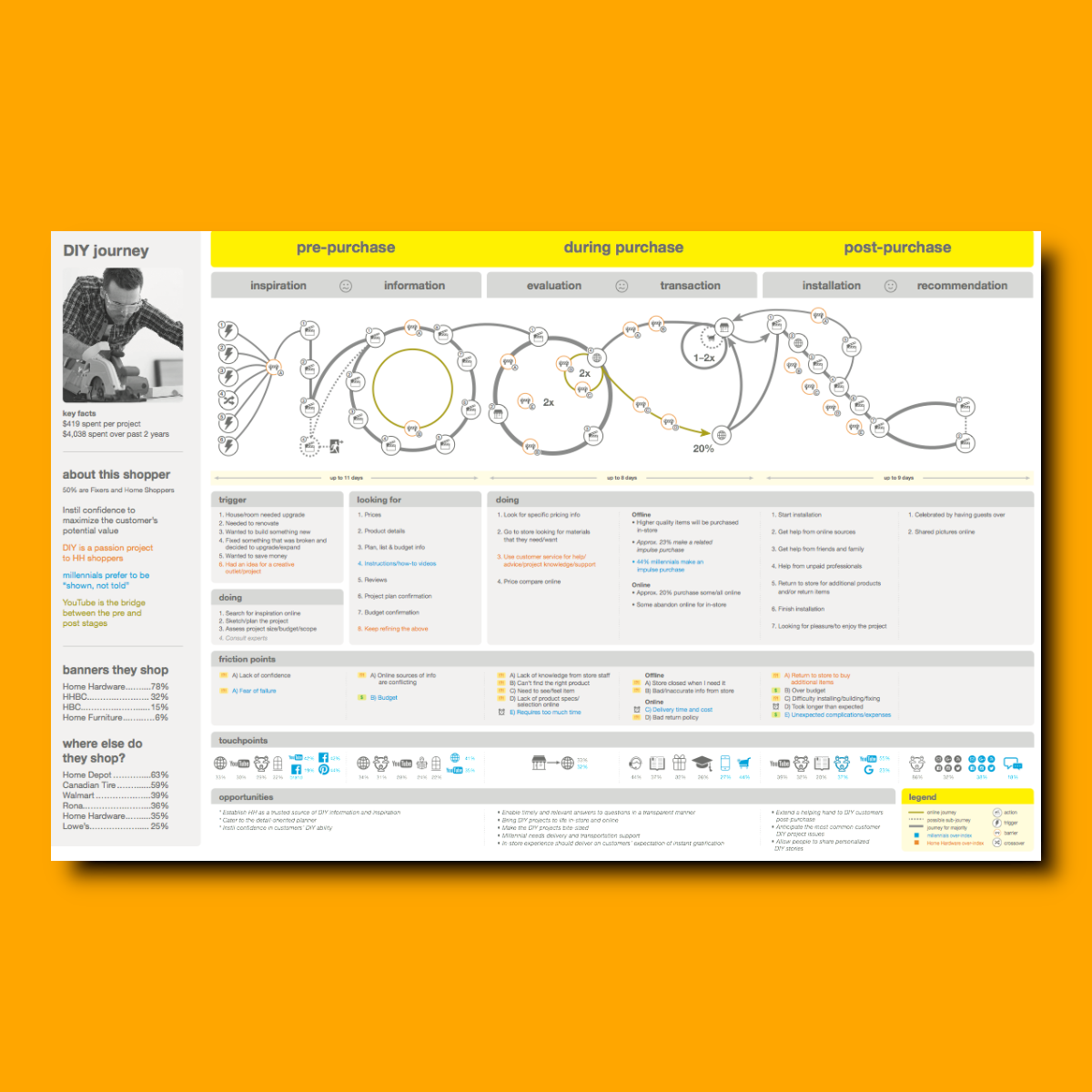

Shopper Focus Groups (experience mapping sessions)
- retraced the steps for each shopper journey
- flagged potential friction points
- flagged potential shopping triggers
Custom Quantitative Research
- quantified and tested the steps, friction points and shopping triggers for each shopper journey
collected information on: - $ spent per home improvement project
- time to complete a home improvement project
- where they go for inspiration, information, evaluation, price comparison, and installation support
- home improvement retailers preference
Executive Summary
- DIY shoppers that lack confidence spend 22% less per project
- 37% of DIY shoppers are starting their project at a disadvantage
- Cost was the primary friction point for the home shopper, often preventing them from moving past the Pre-Purchase stage
- 38% of home shoppers reported “Budget Implications” as their top barrier.
- Despite the urgency of something breaking, fixers are more interested in saving money on their fix-it purchases than anything else
- 75% of fixers are driven by price – therefore they spend twice as long before entering a store trying to find the best deal